

Japan has the longest-living women in the world, and men aren’t far behind. Ask most people why, and you’ll get the same handful of answers every time: fish, small portions, green tea, walking, ikigai, strong communities. Some of that is genuinely true. Some of it is repeated so often it’s stopped being questioned.
In this article, as a doctor currently training inside a Japanese hospital, I’ll walk through what actually holds up in the data, what I think gets more credit than it deserves, and the one factor — almost never mentioned in these lists — that I think explains most of the gap. I’ll also show you where Japan’s longevity has real costs, not just headlines, and how it compares to the world’s other so-called “Blue Zones.”
What is really behind Japan’s longevity
Let’s start with the number itself. According to Japan’s Ministry of Health, Labour and Welfare’s 2024 life table, the average life expectancy is 81.09 years for men and 87.13 years for women. Japanese women have held the world’s #1 spot for most of the past three decades; men currently rank 6th globally, just behind Sweden, Switzerland, and Norway.
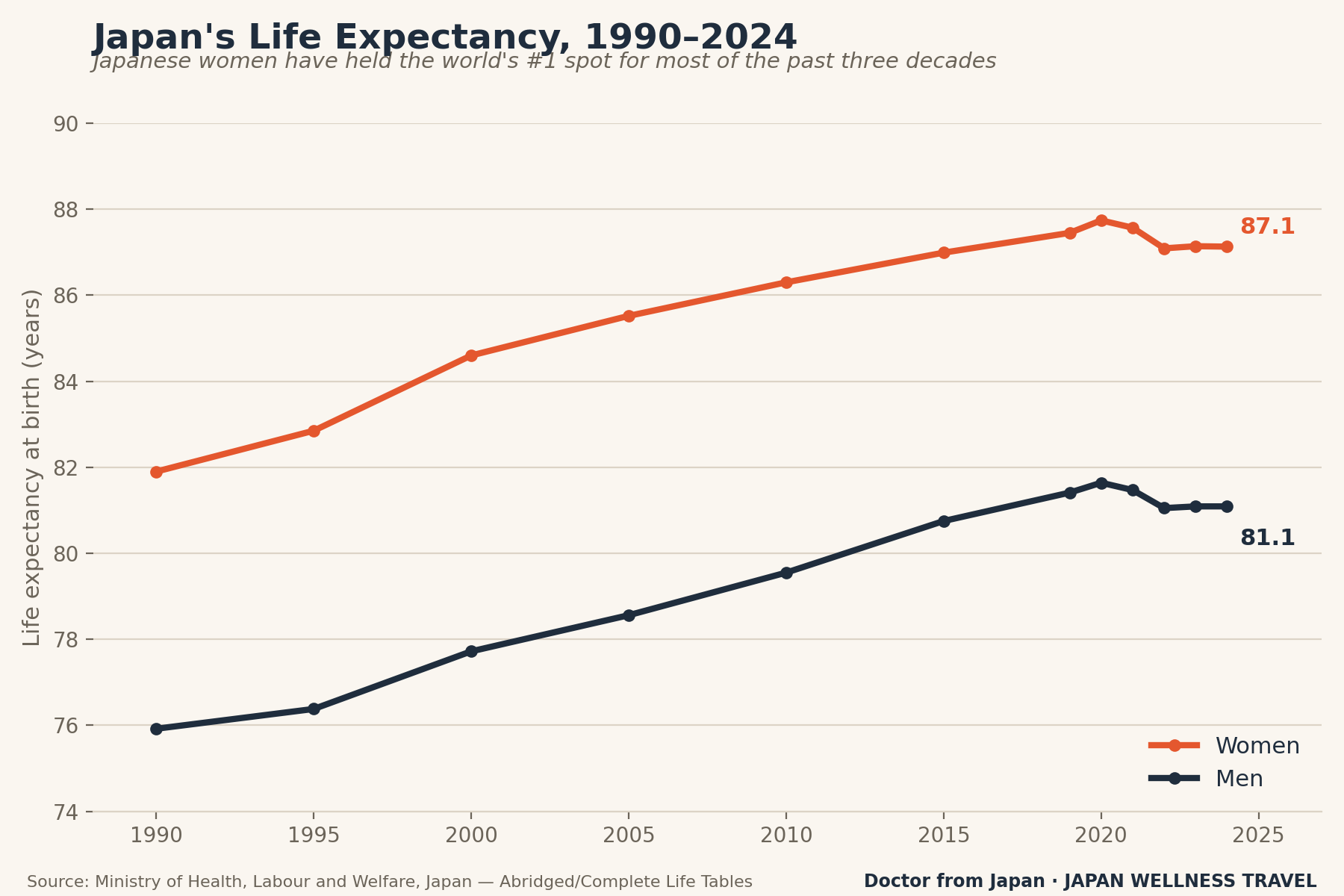
What the chart above doesn’t show, and what I think matters more than the headline number, is a second figure most longevity articles skip entirely: healthy life expectancy. As of the latest government report, Japanese men can expect about 72.6 healthy years, and women about 75.5. The difference between “years alive” and “years healthy” — roughly 8.5 years for men and 11.6 years for women — is a number I’ll come back to, because it changes how I think the whole question should be asked.
The beliefs everyone has — and how many hold up
When I sorted through what readers told me, the answers clustered into three groups: things that are simply true, things that are true but overstated, and one thing that’s quietly the real story. Let’s go through them honestly, one at a time.
What’s true: diet and walking
Diet.
Yes, the traditional Japanese pattern — fish, tofu, seaweed, vegetables, small portions, minimal processed food — is genuinely protective. Hara hachi bu, the Okinawan habit of eating until 80% full, is a real and useful practice, not a wellness cliché.
But here’s the part that surprises people: Japan is not a low-salt country.
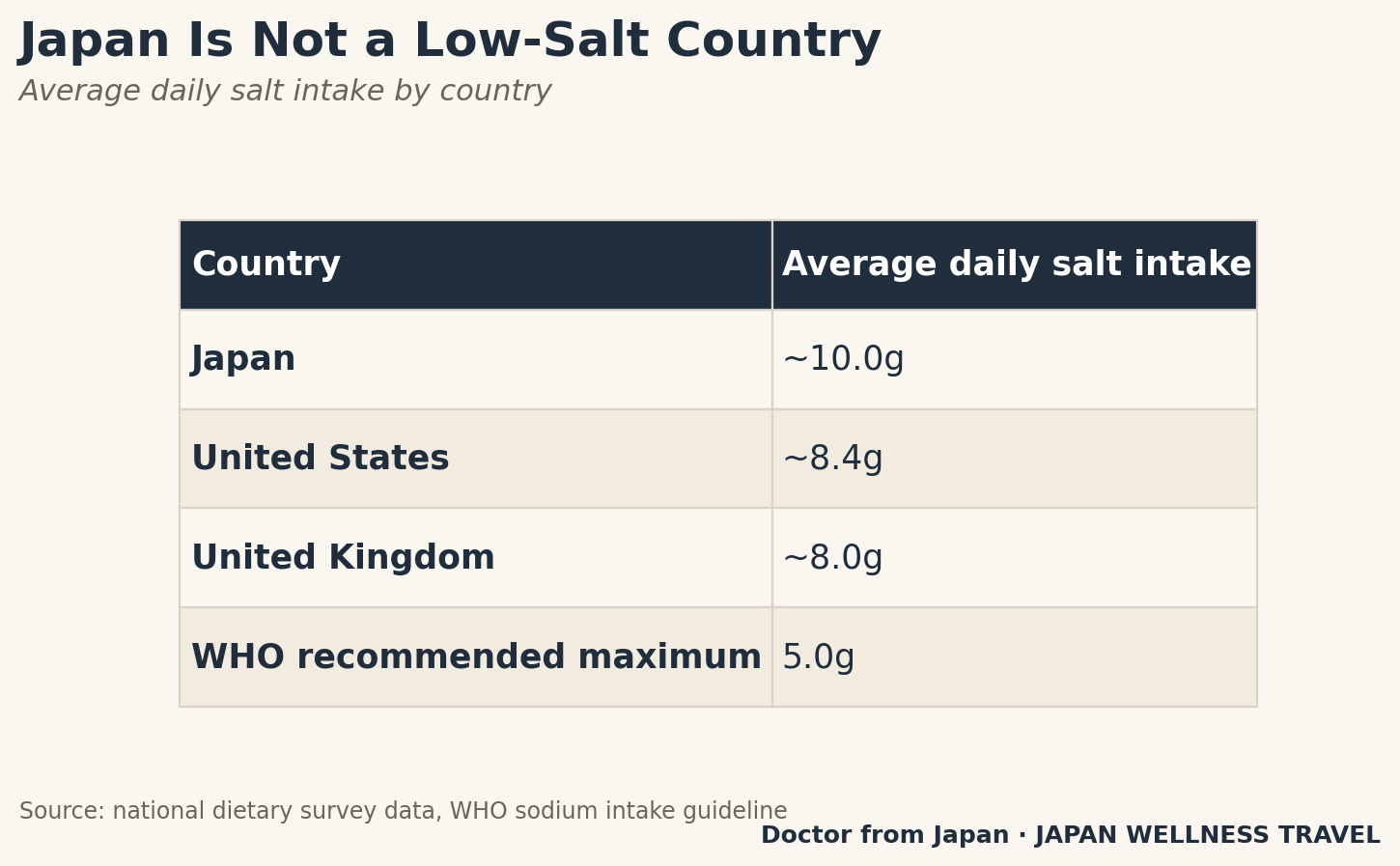
Japan actually sits above the US on sodium, largely thanks to soy sauce, miso, and pickled vegetables — and yet it still out-performs the US on cardiovascular outcomes. The diet works despite this, not because every part of it is optimal. If someone tells you the Japanese diet is flawless, they’re selling you a simplified version of it.
Walking.
This one is simply true, no asterisk needed. Japanese adults average roughly 7,000+ steps a day, meaningfully more than the US average of around 5,000. You don’t need a gym membership when the train station is a 12-minute walk and your apartment doesn’t have a driveway. Movement here isn’t a workout — it’s just how the day is structured.
What’s overestimated: ikigai and social ties
This is the part where I’ll probably get some pushback, and I’m fine with that.
Ikigai
— a sense of purpose — is a lovely concept, and it’s not fake. But I don’t think it’s a major driver of Japan’s longevity numbers, and I say that as someone who lives here, not as an outside skeptic. The uncomfortable truth: loneliness among Japan’s elderly is a serious, worsening problem. In 2024, Japan’s National Police Agency conducted the country’s first full-year national count of people who died alone at home. The number was 76,020 — about 80% of them aged 65 or older. That is not the profile of a society running on deep, protective community bonds.
I’d add one more honest wrinkle here, since it’s directly relevant: Okinawa — the original “blue zone,” the place this whole ikigai story was built on — has itself changed. Public health researchers have documented that younger generations of Okinawans, who grew up on a more Westernized, fast-food-heavy diet than their grandparents, have seen the prefecture’s once-famous longevity advantage narrow relative to the rest of Japan. The story that made Okinawa famous is, at this point, largely a story about people who are no longer under 60.
So: rural pockets of Japan genuinely do have tighter social fabric than most Western cities, and that’s worth something. But generalizing “close community” into “the reason Japan lives long” overstates the case, and the newest data on Okinawa itself makes that case harder to make, not easier.

What I see from the clinician’s side, not the patient’s
Here’s the part that’s easy to miss unless you’re standing where I stand.
Most people encounter Japan’s health system as a patient: you go in, you get checked, you leave with a result. What you don’t see is the volume. On any given week in the hospital where I train, a meaningful share of the people coming through for screening have no symptoms at all. They’re not there because something is wrong. They’re there because it’s the year for their check-up, the way it’s the month for a car inspection — and nobody in the room treats that as unusual.
From the clinician’s side, that changes what “catching something early” actually looks like in practice. It’s not a dramatic save. It’s a slightly elevated number on a routine panel, flagged before the person who owns it has any idea anything is happening. Multiply that across a whole country doing this every year, for decades, and you get a structural advantage that has almost nothing to do with what anyone eats for breakfast.
I think this is the part that deserves to be the headline of the “why do Japanese people live so long” conversation, not a footnote.
The real difference: how early Japan catches disease
Here’s what I actually think explains most of the gap, and it has almost nothing to do with diet.
Japan checks. Constantly, almost reflexively.
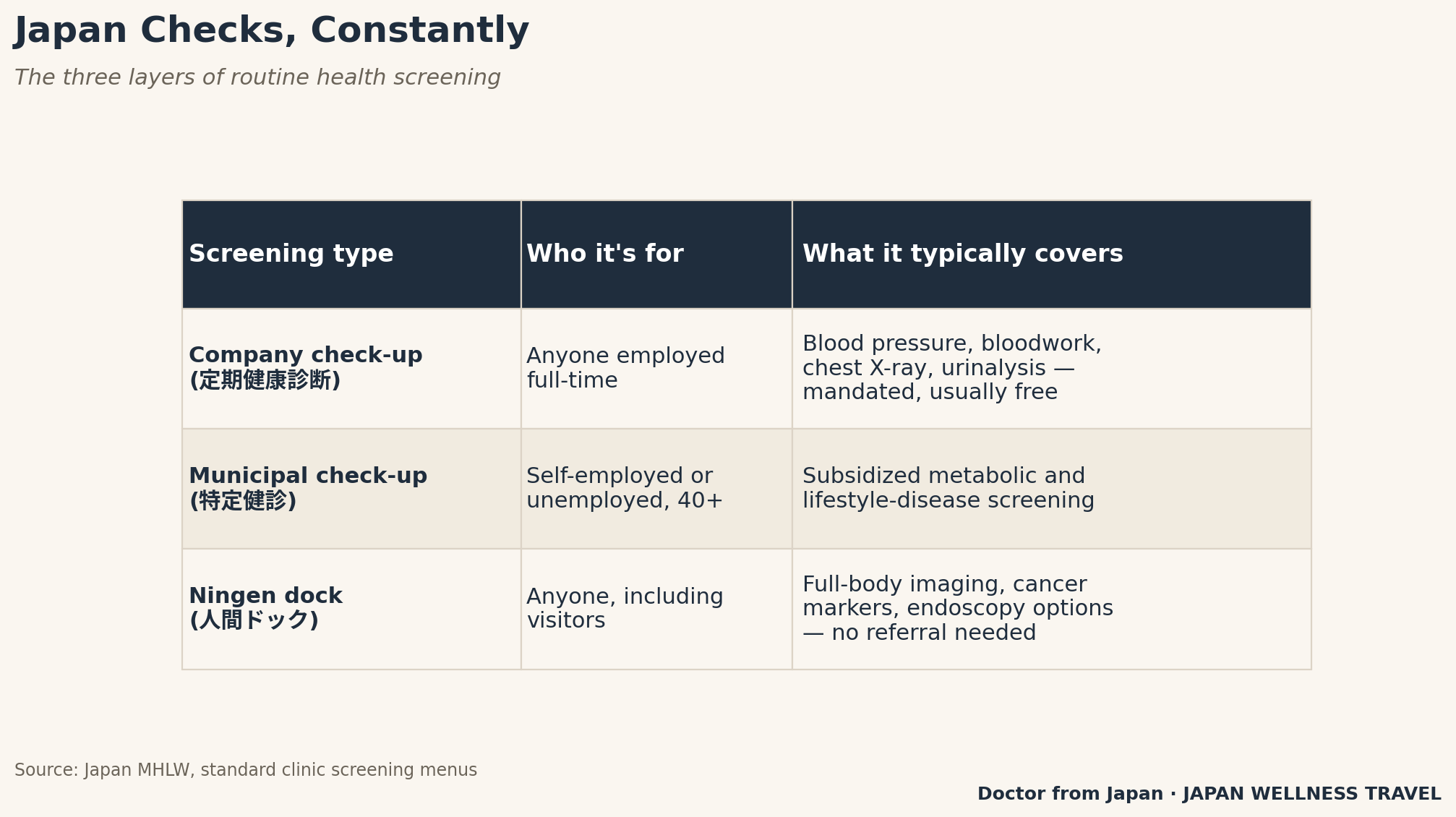
This matters medically because the biggest risk factors for the diseases that actually kill people — heart disease, stroke, most cancers — are things a check-up catches before symptoms show up: blood pressure, cholesterol, early tumor markers, blood sugar trending the wrong way. A culture that normalizes checking these numbers every year, without waiting to feel sick first, will structurally produce better outcomes than one that treats a doctor’s visit as something you do only when something already hurts.
I think this is the single most underrated factor in almost every “Japanese longevity” article out there.
How Japan compares to the world’s other “Blue Zones”
You may have heard of the “Blue Zones” — five regions researchers have identified where unusually high numbers of people live past 100: Okinawa (Japan), Sardinia (Italy), Ikaria (Greece), Nicoya (Costa Rica), and Loma Linda, California. It’s worth seeing where Japan actually sits next to the others, because the comparison itself is instructive.
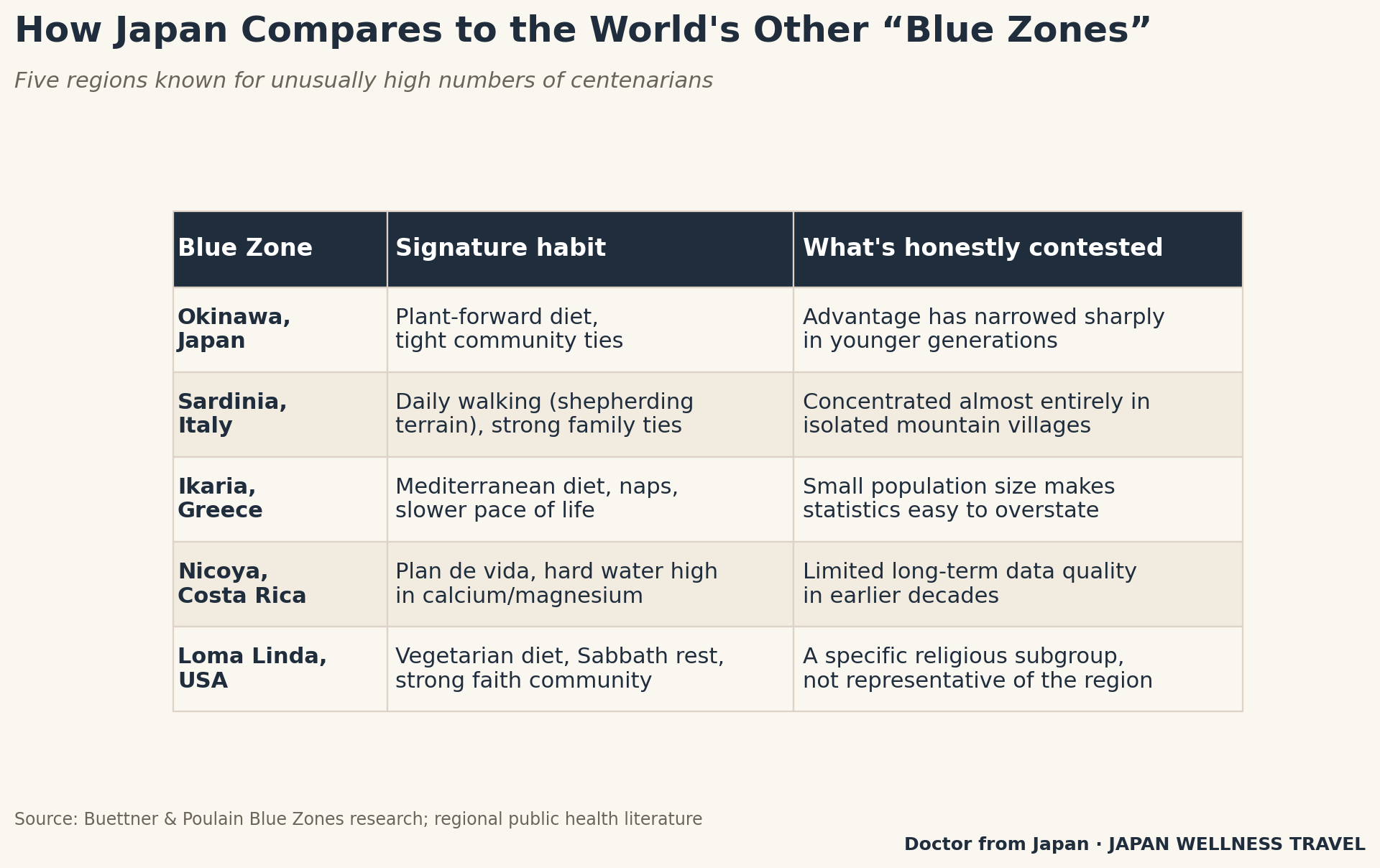
The pattern across all five, including Japan, is less “one secret food” and more “unusually consistent daily structure, sustained over an entire lifetime.” Japan’s national-level advantage — as opposed to Okinawa’s local one — is the only one of the five backed by a country-wide preventive care system, not just a regional lifestyle. That’s the difference I keep coming back to.
The honest downsides
In the spirit of not selling you a fantasy: Japan’s longevity comes with real costs, and I’d rather tell you about them than let you find out later.
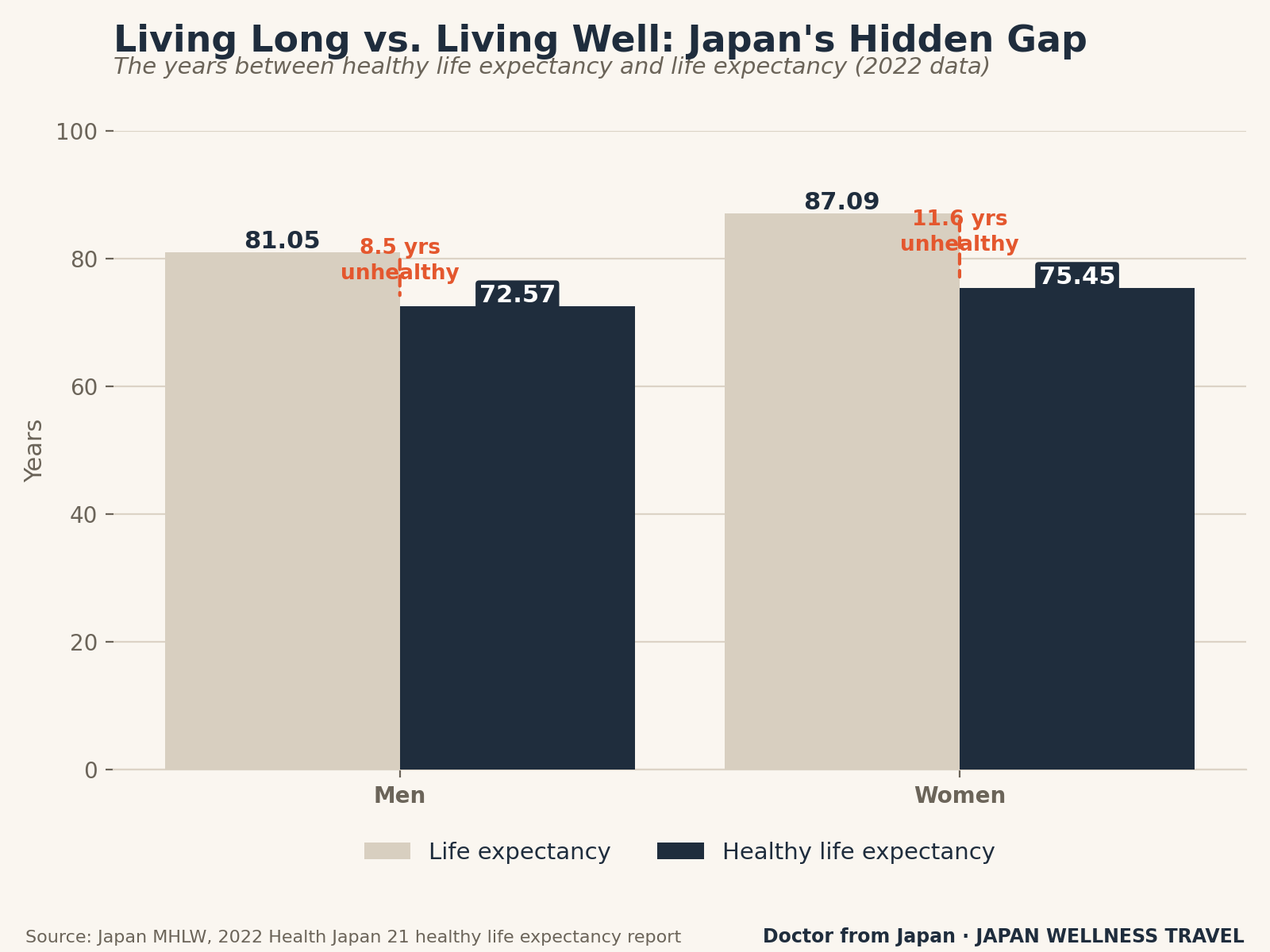
The healthy-years gap is real, and larger for women than men. Living to 87 doesn’t mean 87 healthy years. A long life and a long healthy life are not the same claim, and the chart above makes that gap impossible to ignore.
Loneliness in old age is a genuine crisis here, not a Western media exaggeration. The systems that catch disease early haven’t solved the problem of catching isolation early — and I don’t think any country has.
How to actually try this yourself
You don’t need to move to Japan to borrow the parts that work.
Eat until 80% full, deliberately, especially at dinner — not a diet, just a stopping rule.
Build in unavoidable walking — a longer route to the station, parking further away, stairs by default.
Get an annual check-up you actually keep, including the numbers most people skip: fasting glucose, LDL cholesterol, blood pressure trend over years, not just one reading.
If you’re visiting Japan, consider doing a ningen dock while you’re here. It’s one of the more concrete ways to experience this culture from the inside, not just observe it.
Frequently Asked Questions
Is Japanese longevity mostly genetics? No. Migrant studies consistently show that Japanese-Americans and other diaspora populations lose much of the longevity advantage within one to two generations of adopting a Western diet and lifestyle — a strong sign this is environmental, not genetic.
What do Japanese people actually eat for breakfast? Commonly: rice, miso soup, grilled fish, a small amount of natto or pickles, and green tea. It’s protein- and fiber-forward, low in sugar, and rarely skipped.
Does green tea really do anything? It’s rich in catechins and L-theanine, both associated with modest cardiovascular and metabolic benefits in the research literature. It’s not magic, but it’s also not hype — and it beats a sugary drink at breakfast.
Why do Japanese women live longer than men here, even more than the global gap? Lower smoking rates among women, earlier and more consistent use of preventive screening, and lower rates of alcohol-related liver disease all contribute. It’s a combination, not one factor.
Is Okinawa still the longevity miracle everyone talks about? Less than it used to be. Researchers tracking the “Okinawa paradox” have found the advantage is concentrated in older generations who grew up on the traditional diet — younger Okinawans, raised on more Westernized food, haven’t kept the same edge.
Can a foreigner get a ningen dock in Japan? Yes — no residency or insurance is required at most clinics, though English support varies significantly by facility. This is exactly the kind of logistics I help visitors navigate.
You can read more here.

A final word, as a doctor
If I had to compress this whole article into one sentence, it would be this: Japan doesn’t live longer because of any single ingredient in the diet — it lives longer because it treats “finding a problem early” as a normal part of life, not an emergency.
Curious what a ningen dock actually involves, or thinking about booking one on your next trip to Japan? At Medical Checkup Japan Concierge, I help visitors book comprehensive health screenings at trusted Japanese clinics, in English, with no guesswork about where to go or what to say. Get in touch and I’ll walk you through it.
⚕️ This article is for education, not personal medical advice. I’m a doctor, but I’m not your doctor — for decisions about your own health, please see a physician who can examine you.
This is something I’ve been thinking about for so long!!! Nice article ♥️